---Begins with Honey

Unless there are
health reasons not to, go right ahead and dip.
Honey, Sweetie,
think good thoughts for having made it to this day
Blessing for the year
to come

---Begins with Honey
Unless there are
health reasons not to, go right ahead and dip.
Honey, Sweetie,
think good thoughts for having made it to this day
Blessing for the year
to come
All last week, in our parched California, the news media (online,
in print, and on the air) blared from every possible corner: RAIN IS COMING! (Triple
exclamation, but I’ll stick with one.)
It’s a big deal, after two years of miserably low precipitation.
The day before many times a day the news stations wouldn’t
stop talking about it. Even Queen Elizabeth’s funeral preparations made for
small breaks in what really mattered—
RAIN IS COMING, and it’s going to be BIG RAIN.
Get your umbrellas out of the closet. Be careful on the
roads. You’ll be awakened by possible thunderstorms. Stay inside and bake
cookies on Sunday and be careful going to work on Monday.
I awoke early Sunday and looked outside. Not a drop. I
checked in the back yard where I have a rain collector. Not a drop. It hadn’t
so much as sprinkled overnight.
I went to the curb to put the garbage and recycling bins out
for Monday’s collection. On the other side of the street, I saw a young man
walking, holding an open umbrella over himself and wearing a raincoat. It was
as dry as could be.
I wondered if it was just me or the world had lost its
senses.
Many hours later, it did rain. It rained a little. Then
the sun came out. Later, it rained once more. Also, just a little.
Monday came, and the sun was shining. The hourly news kept
telling us not to be fooled. The sunshine could and would turn to showers at a moment’s
notice.
It never did.
I was happy for the bit of rain. As I said, we needed it. It
also meant I can skip a single yard watering, and every bit counts. But it made
me think of how media lives to augment and distort reality. Not because they
got a weather prediction wrong (this happens), but because even as reality
outside said otherwise, the news kept insisting in real time that it was Noah’s
flood.
I thought about the raincoat-wearing man with the
open umbrella who preferred to believe the news rather than his own eyes.
Many analogies, on the left and the right, popped into my
mind. This is what occurred to me: it is immoral to live off intentional propelling
of hysteria.
I made a note to self to always pay attention to what I am
experiencing, and less to the hyperbolic tendencies of the media.
And when the next rain comes, I will say, “Welcome. Glad you’re
here.” That, and no more.

One of the many gifts of being a beta reader is learning how
a story hits the spot (or doesn’t) on the reader’s end. I have gained as much from being a Beta as from being the one who received feedback from another.
There is another form of reading, one cultivated in
academia, that imposes analysis on renowned books. The philosophies behind
different forms of analysis are super-imposed on the text. I’ve done my share
in school, and have never found it to help my writing. For that matter, I haven’t
found those who excelled in literary analysis to be strong writers of original
fiction. I have personal friends I will never name who fit into this category:
strong academic background, and their original fiction suffered from the
indoctrination.
One may argue, reading this
article, that any analysis of others’ work is beneficial when forging with
your own story. I will not deny this can and does happen. But as a rule, effective
original fiction is intuitive, and the analyzing mind needs to go into lower
gear, like a barely audible background hum, in order to tell a story well.
Another pithy way of saying this, paraphrasing Dr. Seuss: try
to forget what you learned in Rule-going School. Let the intuitive life
force flow. Get on the boat, and let it sail down the river, only occasionally resorting
to use the oars.

©Geraldine Aikman
Memoirists have a special challenge: tell a good story,
driven by themes which must not overwhelm the plot.
My late father was urged to write a memoire/autobiography,
because his life’s story encompassed the momentous events of Jewish history of
the 20th century. He survived the Holocaust (ghetto and
concentration camp) to go to what was then Palestine, and fight to establish the Jewish
state of Israel. He was critically wounded in the battle for Jerusalem. He was
part of a group that established a kibbutz. He went on the represent Israel in
cultural aspects in France and Argentina.
Even one of these chapters would have made a poignant book.
He was an academic historian, and wrote beautifully, having had poems
published. He was the one to tell his story, right?
But he refused to write his memoires. He told me that people
who write their life story inevitably lie, embellish, or seek justification.
“Fiction allows the writer to tell much deeper truths,” my
father told me.
When I first wrote the story that would evolve into a
published novel for middle grades, it was half biographical. By the time it
took its final form, the details were more fiction than fact, and I submitted
it as such. I was told by one editor who wanted to take it to acquisitions that
it would be more likely to be acquired as a memoire. I, like my father, turned
that down. The story had left the honest facts of my life’s story long before, in order (as my father would have put it) to tell the deeper truth and tell it as
a better, tighter story.
One blurb I got referred to The Voice of Thunder as “fictionalized
biography.” Fair enough.
Memoirists have the advantage that when submitting their story,
they present it as true, and it is easier to sell it that way. But keeping it
true while making it tight and compelling is a hard hill to climb.
See this
post about the special challenges of seeking to traditionally publish memoires.

i.e. “LIKES”
Ever since Blogger figured how to not count bots or any
mechanical un-peopled viewers, the viewing counting on my posts went from over
a thousand (most of the traffic back then was from Russia and I know no one
there) to less than a hundred on most posts. Some posts are fewer than fifty.
If you’re reading this, you’re in an exclusive rarified club.
I noticed a curious
pattern to the posts that get almost double the clicks. They either contain cat
pictures (oh, my 💓) or a recipe. I rarely do the latter, so it’s time, don’t
you think? Not that I am motivated by clicks, but I feel like letting the
summer leave with a bang.
And so I will share my favorite comfort food, which is good
warm, (in winter) fabulous cold, (on a day like today) and for the most part is
pretty good for you. It requires only one ingredient you’ll have to go hunting
for, and trust me—you’ll be happy to have it on hand going forward. The rest are
likely already in your refrigerator & pantry.
ROSE WATER PUDDING
2 cups whole milk
2 tablespoons cornstarch
1/3 cup sugar
¼ cup Rose water (or Orange-blossom
water) *
Chopped pistachio meat or Almonds
for topping
*The Rose water is found in middle eastern food stores, and if you must, Amazon also sells it. It’s wonderful in fruit salad and in rice pudding, and for the cocktail crowd there’s no end to where it adds wistful cheer.
On low heat, bring the milk with cornstarch and sugar whisked
in to a soft simmer, using a whisk the whole time. The moment it begins to
boil, it will also thicken. Take it off the stove and whisk in the rosewater.
Fantastic for cold evenings right away. It’s very nice chilled in small bowls
and eaten with a spoon, nut meats sprinkled on top.
Can’t be simpler, can’t be better. You’re welcome.

For a Whale of a tale
August is beginning to look at its end. For me, this is the
time to wind up the initial charting/plotting of the bones to my next middle
grade novel.
All over this land, some dive in during November National
Novel Writing Month, a.k.a. NaNoWriMo. By November, I will be looking back on a
rough first draft I hope to have finished, and take my between drafts break as
the multitude are sweating it out. Early December, I will be on draft number
two.
This has worked for me for the last ten (gulp) years. The point
is to know yourself and do what works for you.
It began with gearing up to the quiet writing-time my kids’
school year afforded. It stayed even after their schooling continues away from
home. I thought about the parents who were robbed of this time during the pandemic
school closures, and was appreciative I no longer had little ones. It would certainly
have broken a cycle that worked so well.
Here’s to hoping I can do it again. Here’s wishing us all a writing
year without interruptions, where the surprises are on the page, not on the
streets.
Or
TRYING TO
It’s easy to note the negatives of this thing we group under
“Social Media,” (SM for short 😈) because it’s plain to see: take-downs, foul language
aimed at strangers from others who can hide under made-up identities, and so
much more.
I decided to articulate here how my reluctance and negative
impressions turned into positive aspects for the sites I have some presence on.
I came to the Internet with trepidation, being told it was necessary if I
considered approaching publishing professionals. That was some years ago. I
stayed and even thrived on a couple of the SS.
So I am articulating my personal journey from trembling to
sunbathing for the ones I have experienced. I know all SS harvest my data; they’re
welcome to it for the service they provide. I am aware at all times that
nothing on SS is truly private no matter how many “privacy protections” they
claim.
This is my own journey in SM-land. It’s different for each
person.
In the order of (my) preference:
PERSONAL WEBSITE: The
very thought of it hurt my insides, and then I got used to it the way one gets
used to a nose ring or a wristwatch. They become a part of self that is barely
felt. Today I kind of like it, because I control what’s on it. It’s the virtual
calling card of the 19th century and the business card of the 20th
century. In the 21st century we deal with this and occasionally fiddle
with the aesthetic to make ourselves feel better about it.
BLOGGER: Came
to it with a heavy heart feeling that 1. It’s a burden to have to write posts
regularly; 2. Who cares what I think; and 3. My publisher’s urging made it
something I had to try. Turns out I like the discipline of posting and I like
having a place to publish thoughts, mostly about publishing. Hey, if you’re
reading this--we’re both here. My blogger is not for selling; it’s a small
hangout that I actually wound up liking.
FACEBOOK:
I joined because DD was on it and parenting advice said parents should know
what their kids are up to. That part turned out to be moot, because kids are not
sharing what they don’t want grownups to see and they have left this SS when
parents joined. But it is the place to find long-lost friends and acquaintances,
find fantastic groups of interest, and Messenger is a marvel for free chats both
video and text with no upfront charge. It is where I have more “friends” (i.e., Facebook friends) and more virtual socializing than any other.
TWITTER:
It feels like walking into a party where everyone knows everyone and you’re
ignored, because they are the cool crowd. After so many years of nominal
participation, it still feels like that. But I’m beginning to not dislike it
when an occasional link is illuminating or an image elicits a faint smile.
There’s hope.
INSTAGRAM:
I set it up as a way to albumize photos of a beloved cat who upped and disappeared
one day. I haven’t changed it since. It’s a story of one lost cat. When I’m
ready to let go and make other uses, I will. Not quite there yet.
Then there’s Tumblr (I follow about five blogs on it now and
then) and LinkedIn
(on it, but no idea why) and jacketflap (Who remembers why I ever set that
one?) and TikTok (where young’uns hang out, but oldies like me don’t).
And before this one posts, there will be many (MANY) more.
All useful, but proceed with awareness. It’s part of the
world we inhabit.

or—
“Mean Girls” are often insecure
Ever walk into a room where others huddle together and,
while not doing anything overtly hostile, do nothing to welcome you in? Then, when
you awkwardly try to contribute, they change the subject and physically scoot
away?
I haven’t had this experience for many years. It’s so very
middle school. In fact, it is at the center of my WIP, a novel for middle
grades. I suspect that when I was that age, I was sometimes the snooty offender,
not the shy newcomer wishing someone would step forward and take them in. Perhaps
this novel is my way of making amends.
I had an interesting experience a few months ago. I decided
to give an online hangout a try, and RSVPed a virtual meeting of women who
write. I’m a woman who writes, so it could be a fit.
Turned out this group all knew each other (virtually) from
previous such Zooms. I was the lone newbie, and let me tell you, it brought
back memories of the less than happy kind.
This time, while the official leader was welcoming (that’s
why she’s the leader) no one else did. I stayed quiet, listening and learning,
and was left with a big question mark pulsating inside me.
I had stepped into a clique. The women were nice (to each
other) and interesting, (for the most part. Hey, writers, as a general rule,
are articulate and interesting people.)— But there was this cluck-cluck of a hen-house
hyperactivity that spoke of wanting to be noticed.
I realized I was
caught in their vibe while also pushed outside the circle, a juxtaposition that
echoed the experience of the main character in the story I’m revising. It’s an
unpleasant place to be, all the more because it exposes how our own vanity and
pride are no virtue.
It also reminded me what cliques are about. Those who
exclude are the insecure ones.
I did get one thing out of my attempt at this new connection;
I revised the story to better express this situation for the main character.
The universe had to send me back to middle school so I could better do my work.

There's a lot in Writers Land about opening
lines and opening paragraphs.
{For example, see this.}
Conventional wisdom states opening paragraphs must hook the
reader at the start and bind them, so they have no choice but to go on reading.
First readers may be agents reading queries, then editors reading submissions
from agents, and ultimately readers browsing at book stores or “looking inside”
virtually, a feature on Amazon.
Most writers know this can cheapen the story somewhat, because
a great story builds up and leisurely luscious beginnings are the mark of many
great novels of yore. The thing is, no one has that luxury of time anymore.
What the Dickens are you thinking if you don’t realize there won’t be a soul
looking at your second paragraph if the first doesn’t grab ‘em by the collar?
And speaking of Dickens, he was a master of first lines. His craft shows awareness of collar-grabbing mastery.
There are posts online where readers chime in with their favorite
first lines.
{For example, see this.}
A first line or paragraph is the narrative voice in a
nutshell. It makes one want to sit close by and continue to hang out and listen as long as
the narrator cares to talk. Openings mustn’t be different from the rest of the story,
or it’s a broken promise. Few things are as disappointing as broken
promises.
To this day, one of my favorites is in Richard Peck’s The
Teacher’s Funeral. The voice, so expressive, continues and delivers the
promise of this opening in spades.
“If your teacher has to die,
August isn't a bad time of year for it. You know August. The corn is earring.
The tomatoes are ripening on the vine. The clover's in full bloom. There's a
little less evening now, and that's a warning. You want to live every day twice
over because you'll be back in the jailhouse of school before the end of the
month.”
I gave this book to many of my kids’ teachers, making sure
they knew it was an ode to teachers and teaching, all the more effective
because it was never teachy-preachy. This opening gives that ironic feel. No
matter how many times I re-read it, I’m newly awed.
Oh, and it’s August, folks.

The subject/title line is
not frivolous. There are writers who feel they have one book in them, and after
writing it (published or not) they have done the deed, had their say, and the
bucket is empty.
I had that feeling with my
first work intended for publication. A philosophical chapter book a la The Little Prince that I mistakenly
thought was a picture book.
I couldn’t imagine ever
writing another story. What more did I have to say?
No one offered to publish
it, and I choose not to re-read it ever again. Mostly because I know now it was
not ready for prime time by any measure, and I don’t want to be stuck in the
mental space that made me write it in the first place. The state that asserted
I have said it all.
It was a strange state
lasting a few months, and once I got through it, the faucet just kept running.
Sometimes it trickles and other times it gushes. But the game changer is that I
know I will never run out of stories worth telling.
Even when I can’t think of
any, I know they are there, just beyond the horizon, waiting for the rising sun
to reveal their shape.
It’s called being alive.

There is a truth universally acknowledged that a picture
book writer in pursuit of le mot juste, must not make it a rhyming one.
Picture books, the ones conceived for the youngest listeners
who adore rhyme. Imagine that.
The reasons agents and editors give is that most of us think
we can rhyme well, but most of us can’t. Add to that are commercial
considerations with a long view to foreign languages editions. Translating rhyming
texts is even harder than rhyming well in the original language.
All true. But still.
Rhyme has charm. Rhyme has beat. Rhyme tickles and tingles the
bottom of feet.
Gotta get up. Gotta dance. Love to rhyme?
Take a chance.

So, as I just demonstrated, it is hard to do well.
But if you must, then do. Take a chance. Some texts just beg for it.
We do know that, up
to a point, age does bring a certain kind of wisdom—
The reflective kind.
Which is why, especially in the thinking/writing arts, ageism
has no place whatsoever.
We are not weightlifters or furniture movers, for heaven’s
sake.
And so if you read one thing today, please
read the article in this link.
[Debuting
at the Age of 66 | Jane Friedman]
Can you tell I am ready, oh so-so very muchly ready, for my
breakout novel?

Another writer, lamenting the steep odds to traditional publishing,
told me she doesn’t need to write and will cease writing fiction if her journey
doesn’t make an upward turn in the near future.
I was surprised. This writer is gifted, exceptionally so. She
spends many hours at her craft. I assumed she, like me, writes for herself
first. I told her that the writing process is a way of clarifying thoughts,
and I couldn’t imagine not doing it regardless of what markets open (or don’t)
for my stories.
She responded that Journaling, (=keeping a diary) serves
that purpose for her. Fiction is a craft that is firstly labor, not a gift to
self.
It’s different for me. Because, and this is a confession
that could put me in the loony-bin in some folks’ eyes, my characters always
surprise me with their insights. They say things I never knew, or never knew I
knew. I grow and learn a lot from them.
Another way of putting it is the unconscious mind needed the
conscious self to open a narrow portal and allow insights to slither out into
the space that words inhabit.
Journaling has never served this for me, and I stopped
keeping a diary many years ago. For me, the entries consisted of emotions of
the moment that overwhelmed any chance for deep reflection.
In this blog I write of what I already know or hope to
learn. In fiction, I learn what I didn’t know I knew.
So, to each their own. I am grateful for all that my
fictional characters taught me, and while I’d love to share them with you, I
will not abandon them regardless of who else chooses not to make their acquaintance.

At 3:08 am I was jolted awake by the screechiest loudest
most gosh-darn scream from my cell phone.
AMBER ALERT!!! AMBER ALERT!!! AMBER ALERT!!!
As the blasting continued, I looked at the text. Something
about a child abduction in a brown Buick. The only option to stop the shrieking
phone was to “erase.” No saving for later. I tapped it ASAP.
And then I laid awake until morning, heart beating fast,
wondering how many bay area residents could possibly spot a brown Buick from
their beds. I was fuming.
This is not the first time this happened, and I always
lament the uselessness of these alerts to all cell phones. When you have one in
our state, you cannot opt out of these alerts on a basic (not smart) phone.
It has happened while driving, and nearly caused me to
crash. There is no way I would stop on the highway to look at my phone. I don’t
answer normal calls while driving, either.
It has happened at various times of the day, and I don’t see
zooming cars from my kitchen, either.
It happened when I was getting an ultrasound by a surgeon
(that’s another story) and she nearly dropped her handheld device.
And that screech: I didn’t know my phone is capable of such volume.
A well-intentioned setting that in fact is largely useless.
If you are not acquainted with the Amber alert system, see
this.
I am all for radios broadcasting (without upping the volume manifold,
as they do now) and especially for the electronic signs on highways.
But how can I possibly help from my bed?
As I lay awake, I realized I was not really angry at the alert.
I was angry that people do horrible things that made others invent such a
system. I was angry that countries invade other countries without provocation.
I was angry that a few bad apples inflict so much harm on the peaceful and
helpful majority.
I learned this morning the details of the abduction, The face of an angelic toddler taken from home by what is reported to be a stranger with out-of-state license plates is haunting.
I’m mad that such happens. Now that I’ve had coffee I’d like to go
out and look for that brown Buick.
But as an aside, don’t shoot me, I’m also grumpy because I
was awakened hours ago in a violent way and am lacking sleep. Some of the best
intentions lead to grumpiness.

Make New Friends but Keep the Old
Those are Silver but These are GOLD
John Parry (1841-1903)
Old friends remember
details we’ve forgotten, and we do the same for them.
New friends
allow one to reinvent oneself.
Both have
important places in life’s journey.
My oldest continuing friendship is more than half a century
and counting. A few months back, when I posted a photo of little me, (in the
context of having been a cat lover from way back) she reminded me that I used
to concoct, compose, and communicate stories about my cat’s nightly adventures
when the rest of our immediate world was in dreamland.
Oh, then I remembered. Seems I’ve been a storyteller longer
than even I had recalled. Back then, as soon as I told the tale— it became a real
tail. A few years more, and I knew what was fact and what was fiction. But the visceral
memory of what it’s like to be an imaginative person of four and five came
gushing in.
Because old friends sometimes know you better than you know
yourself.
Keep the old.

In my yearly cycles, June is the epitome of loveliness and
also loneliness. The latter, because there is nothing specific assigned to it.
June is not exactly summer, though it is.
It’s not (yet) my yearly first-drafting hiatus, but it isn’t
a vacation from writing.
It’s hot, but not. Not really.
What June is: wrap-up time.
In June, I revise winter’s manuscripts. I summarize last winter’s
productivity. Then, I make plans for the re-boot in Fall.
In June, the yearly mega-weeding project is complete. I sit
in the backyard and marvel at how much work May was.
Pat-on-the-back, Girl.
June is like a lovely balloon that floats, but doesn’t fly away.
Sorry, June. You can’t stay.
Working on becoming a better writer is one thing. Then, we have to work on becoming better proofreaders.
Not proofreading well is a pesky problem of mine. It’s one
of those I don’t see what I don’t
see. Of course, much more so for my own writing and ever more if the proofreading
comes minutes after writing.
Standard advice is to put writing aside and look at it
later, as in days/months later. This is not practical for posts responding to online forums or for emails.
.
Relying on Microsoft WORD or GRAMMARLY (insert any other
spell/grammar check of your choice) is foolish. They catch some things, miss
many, and misdirect often.
Let’s face it; some people are excellent proofreaders. Some
of them become editors because of this advantage. But many superb writers
confess they aren’t blessed with the proofreading brain.
{Yup. I *just* had to correct "proofreading" above,👆 because I had typed "prrofreading." 😬 }
An excellent beta reader gave me a helpful suggestion, which I have found to reduce my rate of typos. In addition, it catches echoes; those repeat words coming too close together in a paragraph.
{I like this egregious example of echo: "She looked at him. "Look at it," she said. "When I last looked it didn't look half as bad as it looks now." 😰 }
It’s the text-to-voice feature, where a
mechanical voice reads highlighted text back to you. It’s better than my
reading aloud, (something I also do) because when reading my own words, I often
read what I thought I wrote and not what’s on the screen/page.
Here is what this feature looks like in WORD. Other writing
platforms have similar functions, though you’d have to find them yourself
because I only use WORD. I red-penciled it on the upper left:

In addition to catching echoes, this device is literally an
echo. It, too, isn’t perfect. You won’t catch homonyms with it. But if you
haven’t tried it, you will be pleasantly surprised at how helpful this editing
feature is.
Someone asked me yesterday how long it takes to write a
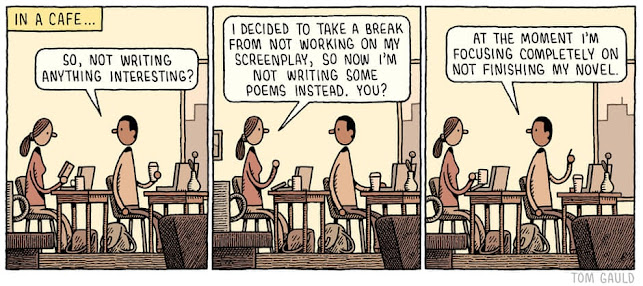
novel. The National Novel Writing Month (=NaNoWriMo, November) makes folks who don't write novels think it takes a month to write a full-length novel for adults.
Articles such as this
(from Writers Digest) give a wild range of two and a half days to sixteen
years.
Seems to me the definition of what constitutes writing a
novel is what needs clarifying, because these estimates are comparing apples
to oranges, or more likely— watermelons to olives. Technically, both are fruits. But this is where the similarity ends.
It’s not only the size and scope, but what do they mean by “writing
a novel in X number of days.”
If NaNoWriMo is the definer, we’re speaking about finishing a first draft. Writers know that is just the beginning. It has become a sort
of fashion among genre writers to fast-draft a first draft. A month’s first
draft will be followed by many more, but you could claim to have written the
novel in a month.
When the claim is that it took many years, we are not speaking of
working on the novel five days a week for years. These books had long stretches of sitting in a drawer, real or virtual, before the writer finished the
umpteenth draft and called it done.
If we look for any kind of metric, those who do not write
novels would do better to ask about the general rhythm or work discipline of
different writers. Every day? Only on weekends? Now and again? How many hours
at a writing session?
And there, too, are wild differences. No wrong and right,
just long and write.
One of my sanity-keeping strategies is to not let go of my
old routines even when external forces no longer necessitate them.
When I became a full-time mom, I relegated my writing to the
rhythm of my kids’ school year. That meant I took summers off. I began plotting
a new Middle Grade in September, with a first draft start date no later than October
first, and a second draft no later than February first.
My writing days were also set, with weekends relegated to
critiquing other writers’ work and drafting blog posts, such as this one.
School vacations were my days off, too. The summer was
re-charge time, with the creative engines beginning to rev up in August. I
jotted notes for ideas, but stayed off the first drafting table while Camp Mama
was active and I was running it.
I no longer have kids at home, and my cats don’t care that
it’s summer. But I keep to my established routines because they have worked
well for me. I never did NaNoWriMo* because I don’t need it. I have my own novel
writing month(s), and I don’t let myself off the hook just because I can.
*National Novel Writing Month= November
In truth, I always could just not do it if I didn’t feel
like it. But I understood this notion to be the enemy of the creative spirit.
It’s not what do I feel like today, but rather— today’s
Tuesday and so this is what I will feel.
Oddly, this isn’t confining; it’s liberating. There’s plenty of time for spontaneity and variety when the day’s work is done, and the work itself shapes a kind of internal liberation.
It’s cutting off the chains of ennui
and touching the light of yes, we can.
Of all the “W”s of
a story, (Who/Where/What/When/Why) there’s another WHY that may be the most
important. Another blogger, Jennie Nash, addressed it succinctly here.
It’s the why you must tell this story.
I see this more
and more with critique exchanges, of which I have done too many to count, and
maybe most of all for picture book manuscripts. I’ve read nicely constructed
stories based on tried and true formulas that are spelled out in writing craft
books and repeated in writerly conventions or blogs. “This is how you should do
it,” is their essential message, which the writer then followed to a T.
Many use so-called
mentor texts. Every bit of how-to advice is incorporated.
What’s missing,
sorely utterly absent, is the passion for the story.
These painted by
the numbers creations remind me of birds without wings. Nice colors, pleasant
faces, point-on beaks.
But they don’t
fly.

It’s far easier to
comb the feathers of inspired stories that, even in an un-polished state,
already soar.
I’ve seen feedback
that try to blow air beneath these flightless stories by suggesting a stronger
action, more tension, tighter phrasing, etc. What the person giving feedback is
not saying (because we try to be polite and kind) is that the passion is
missing.
If you ask: “Why
did you write this story?” A likely answer is a version of “I read
publishers/agents are looking for such.” Or, “my kids liked that other story so
I used it as a mentor text.”
Better: “Why were
you burning to write this story?”
Putting it this
way, I find that with wingless stories there’s rarely an answer.
For myself, I start with that WHY. Why must I write it?
Then it’s a GO.
SO MUCH MORE
I just finished reading a novel whose author, in the Acknowledgements
page, thanked so many people that the page turned into pages, plural.
I’m one of those readers who always reads authors’ Thank Yous.
There, I encounter the good feel of gratefulness, and occasionally a deeper
glimpse into the writer’s process. I rarely know any of the names being
thanked, but it matters not. I like the ambiance; being in the presence of expansiveness
and joy, something I feel deeply for my beta readers and anyone who ever helped
me be a better person.
But here comes my pet peevishness: when the number of people
mentioned goes over, say, ten— it’s diminishing returns multiplied exponentially
with every addition.
Like everything else in writing, (and life), curtailing exuberance
actually has the effect of giving a statement power. I lamented this in an old
post about overuse of exclamation points, here.
I actually went on to count the number of people thanked by
name in the above mentioned author’s river of gratitude. As I did so, I
wondered if some dark part of me wasn’t envious that she not only had so many
people to thank, but even knew this many people. (The number is two-hundred and thirty-six,
but who’s counting.😮) I’m sure every one of them is diminished by the size of the
crowd.
I don’t have an exact number not to exceed. I just wanted to
remind myself (and anyone reading this) that less is more.
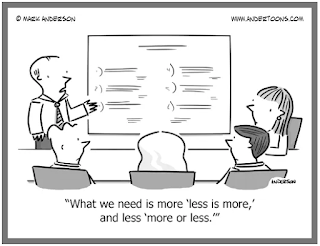
©Mark Anderson 2015
There are many variations on the Cinderella story. This one is different. And yes, it's scrumptious.

The story of Elliot, the unrecognized master baker, outdoes
the traditional tale by giving him a talent where he shines. More than the
original Cinderella, who mostly charmed with her beauty, this hero is
spectacularly gifted. Like her, CinderElliot works hard at home. But what he
has to offer the prince, beyond his good nature, is his brilliant creativity.
And the illustrations by Stephanie Laberis, do just that.
They are scrumptious.
Written by Mark Ceilley and Rachel Smoka-Richardson, the text flows seamlessly. I've known one of the co-authors, Mark Ceilley, for fourteen years. We are in a picture book critique group and I have witnessed as he wrote, revised, polished, and continued to create despite the steep odds to publication. As far as I'm concerned, Mark’s own journey to this momentous day is a CinderElliot story in itself. His distinctive style of marvelous verb use is amply displayed in this luscious tasty tale. CinderElliot's sweet concoctions guarantee they will indeed live happily ever after.
Happy Birthday to a wonderful book 💟
*Yup, I know the extra ‘m’ is not grammatical.
I’m making a point
Some months ago in a writerly Facebook group, someone lamented at her discovery while editing her own work. “Turns out,” she wrote, “I’m a fan of passive writing and telling not showing.” 😰
While I’m
paraphrasing and also omitting some of her original pulling-one’s-own-hair in-shame
post, I will quote my response post in full because I don’t need my own permission
to quote me:
“Passive construction and telling have their
place. Just make sure they don't sit and stay where they are not serving their
purpose. Passive is what you use when you want to fuzzy something and cover
with fog. (Someone *was killed,* no idea by whom.)
Telling is an economical way to get through
parts so the showing parts get to shine by contrast.”
The first writerly mistake is not knowing the rules and why they’re there. The second is to treat writing advice as absolute.
You can quote me on it. 👆
Getting off the preacher’s pedestal now.

*{Matzah in Hebrew pronunciation.
Matzo is Yiddish}
The commandment to
eat Matzo* to the exclusion of other bready/crackery/pastry thingies during the
eight days of Passover divides the Jewish people into those who love it and
those who suffer through it.
I’m decidedly on
the side of the matzo lovers. In fact, I eat it all year round, which is
actually a defiance of the original intended commandment. We are supposed to experience
the difference that befell our
ancestors during their exodos from Egypt. So if you eat matzo every day, how is
Passover time different from all other times?
But I LOVE matzo,
so sue me.
Matzo tastes like
pure wheat. If you like wheat, you’ll appreciate the plainness of this subtle
but fortifying taste. It isn’t mixed with any other ingredients like salt,
sugar, fats or dairy. It’s a lot of flour and very little water mixed, pounded
rolled and baked quickly into thin sheets. Glorious.
But here I am
about to mix it with other things for those who want to do something with
leftover matzo. The only reason you have any left over is because you didn’t
eat the whole box plain. I take pity on you, and offer my mother’s Matzo Brei,(Yiddish
for “fried matzo”) the savory version:
4 eggs, beaten
2 ½ cup milk, mixed into the eggs
A sprinkle of salt, a dash of pepper, a ½ t. of onion powder
mixed in
4 matzo broken into small pieces
1 cup grated mild cheese
Mix all the above
and let it soak together for about an hour.
In a large frying
pan that has a lid, melt 2 T. butter, add the Matzo mixture and spread evenly.
On the lowest possible flame let is
cook slowly, covered, for 45 minutes.
That’s it. No
turning, no fuss.
(Another version
skips the cheese, pepper and onion powder and adds vanilla instead, then top
with cinnamon sugar when serving. But I swear by the savory one as a full
dinner in a pan, with a side of green salad.)
This serves two,
and can be multiplied as needed, depending on the size of the pan. My favorite
comfort food, not only on Passover.

The title of this post is misleading in my case, because technically the money was spent by DH, which technically isn’t me.
Here goes:
Confession time: I’ve not spent much
$ as a writer. I spent lots of time, thought, and effort. Money hasn’t been in
the equation. I imagine for the self-published the money they spent and how
they chose to prioritize is pivotal.
But there was some money spent, regardless. Count membership at SCBWI, a few
conferences, paper & mailing (in the ancient days pre-all digital submissions)
and a few books on the craft or business of writing. It adds up to something.
The latter brings me to the best money
spent from my address. It was a birthday present from DH twelve years ago; a curiously titled The
Complete idiot’s Guide to Publishing Children’s Books.
Note that the word “complete” refers to the
idiotic reader. In reality, this book is more of a complete guide and the
reader is no idiot but a smart person because they know they don’t know.
This basic book was the best investment,
as it did cover almost anything a novice needed answered. As a tiny bonus, it
also served as an acknowledgement of one’s status as a know-nothing, something to
keep inflated egos in check for the barrage of inevitable rejections to come.
For the novice it’s $ well spent.

Those who write
picture book texts know that descriptive passages are best left out for the
art. But what about novels for middle grade readers? They are (usually) not
illustrated. Surely, there’s room for descriptive passages telling of landscapes,
indoor settings and physical details of characters.
Time was, there
were ample spaces in the narration for such. Something happened to change this.
Middle Grade books written today are better served keeping descriptions to a
minimum.
In fact, the
how-to mavens insist that these passages are too “telly," an anathema to the show-don’t-tell principle of strong
writing.
Descriptions also
slow the action, and if there’s anything more verboten, it’s slow-moving plot.
Then, there’s the
matter of descriptions tending to quiet the tone, and “too quiet” is another
no-no.
But-but-but you
say. How is a setting to come alive? How would a character be more than their
dialogue words? Does the young reader ever gets to smell the roses?
It isn’t that
novels for young readers are to be devoid of all description, say the mavens.
Just be economical. Have setting or physical characteristics be inferred by
actions of dialogue. By all means, insert a sentence here and there pertaining
to a descriptive detail. What a writer should avoid is long, languid, lulling
descriptions we all read if we read the classic books of yore. La-di-da and all
that.
It’s a reminder
that we’re competing for shorter attention spans conditioned by video games and
motion pictures.
I know this is
solid advice, but it makes me sad. Some of the best writing I’ve encountered in
my life bore the vestments of detailed descriptions that went on for pages. But
the world of literary commerce has moved on.
Some months back, I
served as a beta reader to a talented writing friend’s middle grade story,
whose descriptive paragraphs were beautifully done. In my humble opinion, her
strongest writing lay in those paragraphs. It hurt to suggest she might consider
cutting them out or changing the way the settings materialized on the page. But
nineteenth-century writing does not work well in the twenty-first century.
A new era requires
new skills. No use fuming or crying about it.

Or—
What Would I Do Instead?
Our neighborhood trusted
gas station/car repair shop has had the same sole owner for fifty years. I wasn’t
here to verify this, but so I’ve been told. For at least twenty, we’ve brought
all our cars to him and he has always been scrupulously honest. His loyal assistant
has been there for as long as I remember. Bridgeway Service
is venerated and loved by all who had experienced the decent way they conduct
their business.
A few years ago, I
got into a conversation with the owner, who told me he would love to retire.
What he really wanted to do was experiment making homemade barbecue sauce and
invite his neighbors to sample his ever-evolving creations on that front.
This stayed with
me, and every time I drive in to get gas or inflate my tires, I think of a
dream delayed when I see Steve, the owner, still at it.

At this stage of
my life, I have the privilege to be able to dedicate myself to doing what I most
want to. I write fictional stories for young readers almost every weekday. I
try to imagine what I would do if writing fiction became impossible. A few
notions float by on wispy clouds~~~~~
Run a cat rescue
Write movie reviews
Make biscotti from a family
recipe I improved
Those misty
billows evaporate as quickly as they appear. I could do any of the above, but
not every day or every week. This cements my feeling of gratitude. I’m lucky to
be where I am.
It also seems
unfair, as Steve from Bridgeway has worked harder all his life, and has earned
his right to make barbecue sauce full time. Life, really, isn’t fair.
Do you have any
dreams delayed you would be open to sharing? I wish you the vision to see
clearly the way to fulfilling those.
Where I live, in California’s bay area, there is basically
only one season.
Lucky us, the season is SPRING.
It goes something like this:
Bay area summer = Spring with morning fog
Bay area fall = Spring without the morning fog
Bay area winter = Spring with some rain
Bay area spring = well, just spring
I have dealt with this boring blessing by creating
seasonality in artificial ways.
Example—
I change the bed’s quilt, and thus my bed reflects seasonality.

SUMMER^

FALL^


SPRING^
The cats are perennial.
It occurred to me that the stories I write are similar. My
life is a steady road with mini-bumps for variety. The stories are life accentuated,
outlined, marked with eye-popping swatches of drama.
The bed frame is akin to the daily discipline of writing, and the cats (i.e., the stand-ins for the
narrator who is me) are the constant sentient beings. The quilts serve to delineate the titles from each other.
Thus, stories are life with spicy seasoning.
🌻Happy Spring🌻
