Showing posts with label Discipline. Show all posts

Tuesday, July 15, 2025

DEADLINES SET BY OTHERS


One of the pitfalls of staying in school for many years is the dependence on deadlines set by others.


What, you might be saying, is wrong with that? It’s a preparation for work life in general and makes John and Jill good boys and girls. Right?


But here’s my take. It also creates a dependence on others to get things done.

I know writers who sign up for writing challenges and join groups that insist on certain timed output. I know musicians who need competitions to get them going on learning new repertoire and practice . I know painters who need a set exhibit date to complete a set number of new works, etc.


Without this external pacing, many people just fall apart and lose the map. The trail becomes blurry and a sense of being lost takes over only to deepen unless they latch on to yet another organizer who gives them deadlines once again.


I have come to see it differently. It took reaching my late twenties before I got that monkey off my back. I learned what pace works for me and why only this way of working sets me free.


Sure, I meet deadlines all the time. But I don’t need them to create.


You won’t find me anywhere near NaNoWriMo or the 12 by12 challenge and their ilk. Maybe because I didn’t stay in school as long as many I know, I don’t need this sort of assigned homework. Life tells me when I’m needed, and I tell my days what I need from them in return.


Tuesday, May 31, 2022

HOW LONG DOES IT TAKE TO WRITE A NOVEL?


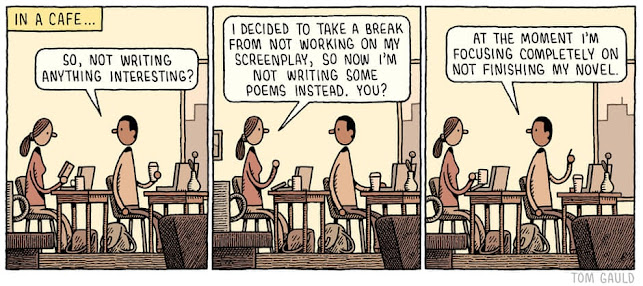
Someone asked me yesterday how long it takes to write a novel. The National Novel Writing Month (=NaNoWriMo, November) makes folks who don't write novels think it takes a month to write a full-length novel for adults.


Articles such as this (from Writers Digest) give a wild range of two and a half days to sixteen years.


Seems to me the definition of what constitutes writing a novel is what needs clarifying, because these estimates are comparing apples to oranges, or more likely— watermelons to olives. Technically, both are fruits. But this is where the similarity ends.


It’s not only the size and scope, but what do they mean by “writing a novel in X number of days.”


If NaNoWriMo is the definer, we’re speaking about finishing a first draft. Writers know that is just the beginning. It has become a sort of fashion among genre writers to fast-draft a first draft. A month’s first draft will be followed by many more, but you could claim to have written the novel in a month.


When the claim is that it took many years, we are not speaking of working on the novel five days a week for years. These books had long stretches of sitting in a drawer, real or virtual, before the writer finished the umpteenth draft and called it done.


If we look for any kind of metric, those who do not write novels would do better to ask about the general rhythm or work discipline of different writers. Every day? Only on weekends? Now and again? How many hours at a writing session?


And there, too, are wild differences. No wrong and right, just long and write.

©Tom Gauld


Tuesday, May 24, 2022

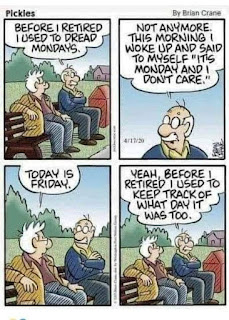
KEEPING TRACK OF THE DAYS


©Brian Crane


One of my sanity-keeping strategies is to not let go of my old routines even when external forces no longer necessitate them.


When I became a full-time mom, I relegated my writing to the rhythm of my kids’ school year. That meant I took summers off. I began plotting a new Middle Grade in September, with a first draft start date no later than October first, and a second draft no later than February first.


My writing days were also set, with weekends relegated to critiquing other writers’ work and drafting blog posts, such as this one.


School vacations were my days off, too. The summer was re-charge time, with the creative engines beginning to rev up in August. I jotted notes for ideas, but stayed off the first drafting table while Camp Mama was active and I was running it.


I no longer have kids at home, and my cats don’t care that it’s summer. But I keep to my established routines because they have worked well for me. I never did NaNoWriMo* because I don’t need it. I have my own novel writing month(s), and I don’t let myself off the hook just because I can.

*National Novel Writing Month= November


In truth, I always could just not do it if I didn’t feel like it. But I understood this notion to be the enemy of the creative spirit. It’s not what do I feel like today, but rather— today’s Tuesday and so this is what I will feel.


Oddly, this isn’t confining; it’s liberating. There’s plenty of time for spontaneity and variety when the day’s work is done, and the work itself shapes a kind of internal liberation. 

It’s cutting off the chains of ennui and touching the light of yes, we can.


Tuesday, August 24, 2021

WRITING AS A KIND OF SPIRITUAL PRACTICE


Definition:

spiritual practice or spiritual discipline (often including spiritual exercises) is the regular or full-time performance of actions and activities undertaken for the purpose of inducing spiritual experiences and cultivating spiritual development.


This calls for defining “spiritual,” so here’s an attempt from me —

Spiritual: Relating to or affecting the human spirit or soul as opposed to material or physical things.


There’s no question that, for me, writing is a spiritual practice.


Tuesday, March 16, 2021

What Are Common Traps for Aspiring Writers?


The question is evident in plenty of interviews, posed to published authors. It’s a variation on “what would you tell your younger/pre-published self,” or “what advice would you give young’uns,” period.


I posit that the question itself is wrong. An “aspiring” writer is one who never writes but has a yearning to be a writer. Don’t’. Be. That.


We are what we do, truly. 

 If you write in a semi-regular way, you are not aspiring; you already are a writer. What the questioner means is “aspiring to be published.”


“Be published” in the passive tense, means someone else is publishing your writing. Self-publishing is not an aspiration, because it’s also something that is entirely in the writer’s hands and requires a credit card. Either you do it or you don’t. Don’t aspire; just do, if that’s the way for you.


Back to the title. My not humble enough view is that the most common trap for one who wishes (i.e. aspires) to write is they don’t do it.

WRITE.

Down with aspiration. Onwards with perspiration.


Tuesday, March 2, 2021

Does Writing Energize or Exhaust You?


A good friend who is a prolific reader but doesn’t write asked me a variation of the this post's title question.

Hers was more along the lines of “do you love to write?” or maybe “do you need to write to be happy?”


I thought of an answer one of my favorite authors gave to the question. Polly Horvath is a master whose prolific output would suggest she lives to write. When asked if she loves to write she said, “I love to have written.


That about sums it for me as well. Before any first-drafting day, no matter if it’s a novel or a picture book, I feel anxious in a vague way. I recognize this feeling as a sort of fear. Fear that I can’t, fear that I don’t have it in me, fear that if I don’t I never will again.


Then I sit down and write. After the day’s self-assigned output, I have a feeling of calm that I now recognize as a sort of peace. I might even liken it to a calm version of bliss.


So there it is: I love to have written.


It also answers the question in this post’s title. I am drained but also filled. I am exhausted and energized at once.


Anyone who confronts fear and comes out the other end knows this feeling.


Tuesday, September 15, 2020

The FUTURE?


The other day, a writing friend said it was hard for him to write to an unknown future.

I offered that the future, by definition, is unknown.

“But with all that is going on, it’s hard to plan,” he said.

True.

My suggestion, which is also what I do, is plan anyway.

There’s a paraphrasing of an old Islamic Hadith, said by Martin Luther King Jr., “Even if I knew the world is going to end tomorrow, I would plant a tree."

Works for me.

What does this mean in real life context? I’m writing, while making sure we have enough toilet paper for the next who-knows-what. I can’t plan for every shortage, so if the next one will center on hairnets, tea or open-toe sandals, I may not have a sufficient stash. But I will have toilet paper, and also writing paper, and enough sense to know that there’s never a better time to plant a tree.

Onwards.


Tuesday, September 8, 2020

The Last Few Months


A writer friend reminded me that as different as these last few months have been, for many of us they were more the same as the pre-pandemic world.


Because books are books, and stories are stories, and the things that matter are very much the same.


But the publishing world is trying to access what is different, not what is as before. As they do so, those of us who want to be published are swinging in the breeze of changing winds.


To that end, I’d love to hear from others. Have you found that you are reading/watching differently? Have your book-buying habits changed? If you could rule the publishing world, what do you wish you could find on virtual shelves?


Maybe the most surprising thing, for me, is that at the height of the rapid closures and public tension I found it hard to focus on reading or writing original stories. But shortly after, (shortly here means about eight weeks) the ability to be a reader and also a writer returned with aplomb. What about you?


Tuesday, August 4, 2020

Managing Time


a.k.a “Time-management”

“Where did the time go?”
“Forwards, darling. Always forward.”


Time marches in one direction and, except for sojourns of the mind, don’t believe the physicists who tell you it’s the fourth dimension and as such it is a line you can move your dot on in either direction. Those same scientists also say the earth is round and, hey, it looks pretty flat to me.
My jesting way of saying our experience is that time runs like sand through our sieving hands.


Some years ago, I was blessed with finding a personal key to managing time. It came just in time, (pun intended) when my life became impossible to manage as a classic “sandwich generation” mom and daughter. But I had the tools, and by golly, I managed to take care of all my responsibilities and also write original fiction.


The key, for me, was to set a daily schedule of the minimal I must get done, and make it utterly doable. If anything, make it “under-ambitious,” so tackling the day’s tasks was not daunting. This is a system set for a marathon, not a sprint. I not only got the “must-do” done, I was less stressed about my time.
And here’s the secret kicker: always leave some time for nothing. That is nothing planned, where I can do nothing, do something I want to do, or attend to the inevitable emergencies that pop up. Nothing Time is sacred, and it is part of time management success.


With the rare exceptions of chaotic days (I take that possibility for granted), this system works for me to this day. Time moves forward, and I’m gliding on it.


I hope you find what works for you, so you don’t look back and say you didn’t get to do something you always wanted to do because you didn’t have the time.


Tuesday, March 3, 2020

Fear of Unfinished Projects

I have a fear of unfinished projects.


It could have started with a rather ambitious project that, in hindsight, turned into a traumatic event. I was four years old when my mother discovered that all of her feminine napkins disappeared. Two packages, which she discovered an hour later in tatters, cut into various shapes.


“What is this?” she gasped. “Did you do it?”

“I am making an airplane,” I explained. It made sense to me. The feminine napkins had one side colored a lovely pink, which I thought made perfect, lovely, fluffy seats.

“You are making what? With what?” she said. Actually, she screamed.


I never made that airplane. My mother’s yelling knocked the air out from beneath my wings.


Many other creative bursts that went nowhere followed. At the age of twelve, filled with nascent romantic notions, a friend who lived about a five minute walk away wound up staying until midnight as we feverishly “made a book” using pop song lyrics and magazine cutouts for each page. It was so much fun she forgot to call her parents and let them know where she was. We vowed to continue our book the next day, and she again forgot to tell me that her parents grounded her when she appeared at the door so many hours after they alarmed everyone they knew including the police. That book of romantic song lyrics was never finished.


I had creative bursts that left feverishly begun and then abandoned projects throughout my teens and twenties. I was twenty-eight before I figured how to work.  


For me, it entailed a solemn vow to not begin something until I finished the last thing.


When writing, “finishing” is never final and done. But to me it means the first draft is written, then a second draft, and then at least one beta reader gave feedback and I revised again. That makes three drafts. After that, a story may sit in the digital drawer or go on to many drafts and revisions. But every manuscript, short or long, will include a typed last line, THE END.


This deal I made with myself has saved me from starting what I couldn’t or wouldn’t finish, and from hundreds of begun-but-orphaned roads to nowhere.


©Doogie Horner

Tuesday, February 12, 2019

Writerly Routines


Most folks have routines that get them going no matter what sort of work they do.
Most writers I know, or know of, do their creative work in the morning. If writing is in addition to their day job, this means very early morning.


No matter when or what, routines help. It’s unglamorous. Admitting that you don’t write drunk into the wee hours of the night with existential despair as page after page is scrapped because you won’t give up until you have something--- doesn't sound arty.
(Oh-so very unlike Dashiell Hammett, at least as depicted in Lillian Hellman’s Pentimento.)

Most writers have a set routine and write no matter where inspiration chooses to dwell any given day. Most workers go to work no matter how enthusiastic they feel at a particular moment. Same thing.

© Luci Gutierrez for the New Yorker


My morning routine is as uninspiring as it is grounding. With small necessary adjustments, it generally goes something like this:


*Woken up by Nougat, one of my three cats. She thinks she’s an alarm clock.
*Thanking her, and thanking G-d for returning my soul to me. It’s a Jewish prayer that sets the day right.
*Making my bed. The other cats come in to help, with great merriment for all.
*Cleaning litter boxes, changing water bowls, filling the food bowls. Felines have priority because of all their help.
*Making strong tea with foamy milk. Drinking it, doing my best to keep cats off the foam.
*A short meditation. It’s supposed to be quiet time, but the cats determine this as well.
*Turn on the computer. Open WORD.
*I’m ON IT.


Two hours or so later, DH gets up and the rest of the day commences. That means coffee, breakfast, and the busy-busy stuff.


Do you have routines to get going?


Tuesday, November 27, 2018

NaNoWriMo* Part 2


*I explained this in an old post, here

As the month of November comes to its inevitable conclusion, all across this land writers either pat their own backs because they made it or wail that they did not reach the goal of fifty-thousand words in thirty days. The latter is more common, as it turns out.


I hope that if you participated you made your goal. I hope that if you didn’t make it, it was worth doing anyway.

But I must say I don’t get it.


Writing by the word count is something I finally understood as helpful to pacing in a novel. Butt-in-chair is also something I understand. Sometimes it’s just like that. You have to sit and do it, muse missing. Writing every day is what many think is the only way to do it if you are serious.

But writing with the crowd?


For me, the very notion that I am part of millions doing the same thing at the same time is an anathema. I have no illusions that when I sit down and conjure a story I am doing something no one has ever done before. But, at the same time,I tell myself I’m doing something of singular value. If I don’t do it, it won’t be done.


I also found the value of the self-discipline. "Self" here stands for creating in a pace and a manner assigned to oneself. I struggled with this issue until my late twenties. I had no problem meeting others’ deadlines. But I rarely managed to finish anything that no one was waiting for and that was self-assigned.
Then I found a way, and I’ve been fortunate ever since. Thank you, the great guardian of creativity, for this gift.


If National Writing Month is your thing, I raise a toast to you for the fine effort. I hope the result is just as fine. But if you failed to meet this goal please consider that your way of creating may not fit with this painting party, and keep looking for how *you* work best to do your best work.


Tuesday, March 6, 2018

Holding My Horses

There are a lot of ‘how-to’ books about how to become a writer, i.e. one who produces regular output of writing with the intention to publish. Whole chapters dedicated to the disciplinary aspect say to—

Write every day [many successful writers don’t)
Write until you have produced X-number of words/pages (Ditto^)
Set a time and don’t vary nor let anything get it the way (Ditto^)

{I will admit this last one is one I have found to work for me. I’m a five-days-a week morning writer.}


But what I have not found in any of the mavens' sites or books is the suggestion to not overdo it.
 Of all the things I have learned about myself, this one has been the most helpful.
 

So here it is:

No matter how inspired I feel and how well it’s going on any given day, this is not a horse race. I set a maximum of pages/word count/time that I will not exceed.

Because there is no reason for a self-caused burnout. I’m in here for the long haul.


For me, this has meant a personal minimum and a maximum output. This is not a fixed output, because novels and picture books are different in this regard, and I write both. But for either, I have come to understand how important it is for me to hold my fire and my horses. 

I intend to write for as long as my life and focus allows. I hope that will be many more years.

And you know what? Of all the how do I do it, this one is the hardest, especially at times. But it turned out to be the most helpful. I doubt I would’ve braved a second, third, or fourth novel without sticking to not overdoing.


Here's to a productive lifetime. Understanding how you work, and finding what works for you.

Tuesday, February 6, 2018

SACRED TIME

Or—
Why “I just don’t have the time” doesn’t fly

A dear friend who is an accomplished musician lamented that she has not been able to touch her instrument in ions. Life’s demands have gotten all of her time and stamina.

This reminded me of countless occasions where someone said to me, “I’d love to write,” or “I started to write,” and invariably followed with “but I couldn’t find the time.”


I used to be that person, also.

Some years ago, I realized that the only way I know to get from under this sort of loop is to think of what I want to do most for myself and what time I can practically quarantine on a regular basis, and then treat that time as sacred.


“Sacred” is not just for the religious. It means a realm not be violated for any but the few reasons I set ahead of time. Even the most orthodox Jews will break the holy Sabbath if it is a matter of life and death, but for no other reason.
I made the decision that only medical emergencies of self or family will break Sacred Time.

For me, this meant setting a reasonable amount of time five days a week for writing. I disconnect the phones, (or their ringers, anyway) and I don’t answer them-- or my door. Sorry if this seems fanatical, but to do anything with consistency, (something the world doesn’t necessarily rewards and is “just for me”) required fanaticism. I don’t apologize to anyone who knocked on my door, virtual or physical, for making that time scared.


Realistic demands, job, family care, health maintenance and communal obligations will determine how much sacred time you can allow. It can be five minutes a day (meditation, or stretching exercises) or half an hour, or many hours. Realistic self-knowledge will determine if you make it once a week, every other day, or daily. But is must be sacred if you are to live it for the long haul.


Because otherwise, the “I always wanted to but...” will become yet another relic in the half-done, once begun, couldn’t stick it out box of broken promises. Too many of these lying around everywhere, and I resolved not to add to that heap.

The key word for me was Sacred. That was many years ago, and I can vouch that it worked.