Showing posts with label Novels. Show all posts

Tuesday, May 13, 2025

The Matter of the AUTHOR NOTE


I’m fond of reading Author Notes at the end of novels, but I may be in a minority.


To be clear, I understand the reluctance many feel about this matter. I want to be succinct and say that, for me, an Author Note is satisfying to read only if it’s short and personal. Like a cherry on the slice of cake I just managed to finish.

An added zing, a finishing touch. An Author Note needs to work like a decorative bow tied to a well wrapped gift.


A good post on this can be found here.


For fiction, it’s important not to slip into lecture mode. I’m afraid the tendency to explain, self-analyze, and even apologize— is what many authors pass for their final note. I plead guilty myself.


A good Author Note does one simple thing: it ties the fictional story to the author’s life experience in a way that enriches the story for the reader. Too many authors write these notes to make up for what they perceive will be criticism or in response to Beta readers’ feedback. An Author Note shouldn’t be a defense of one’s work, nor added material that should have been woven into the story itself.  Again, I plead guilty to these faux pas.


While Author Notes can enrich a novel, I find them a burden when tacked to picture book texts. Writers who have polished their skills writing for the educational market are prone to add Author Notes to trade picture books, sometimes longer than the story texts. Thus, a fictional tale becomes a mini textbook. Publishers seem to love this, because it makes these picture books marketable in both the trade and the educational markets.


I’m not a publisher. As a reader, I never liked fiction laden with footnotes, and these Author Notes (as well as “Side Bars”) sink fun fiction faster than I can say PLEASE DON’T.

For the third time, I plead guilty to this, also.


So, my take on Author Notes is keep it interesting and above all—

keep it short.


Tuesday, October 15, 2024

REAL REALITY, REALLY?


Friends of mine, living in Israel, told me their GPS has stopped working.


“It keeps insisting we are in Beirut,” they said.


They called their phone carrier and also the makers of the app, who gave them the runaround and finally admitted the IDF has been scrambling navigation in order to foil the GPS-guided missiles coming from the northern border.


Before they got the real answer, I suggested different possibilities, including an IDF action, as to why their phone set them in a neighborhood in Lebanon’s capital. My last suggestion, tongue in cheek, was inspired. “Perhaps,” I said, “you are in fact in Beirut and you’re the only ones who don’t realize it?”


This would make a good novel, I think.


This got me thinking about the real-life couple who followed GPS blindly, which led them to fall into a hole in the ground. Another family took Google Maps voice navigation straight into a dead-end desert road.


All of these would make good stories and should be developed further into tales of digital worlds replacing our flesh and blood eyes and ears experiences.


And speaking of the rare but real flaws of digital navigation, our schools have stopped teaching a new generation how to use printed paper maps. For all the real-time information they lack, they remain an important tool. For that matter, learning to orient with the stars should also be part of basic education. Just sayin’.


Because you never know when the next time the digital masters will decide to re-set our reality.


Oh, wait. They are doing it in many ways already.


Tuesday, June 25, 2024

WHEN AN EYE FOR AN EYE LEAVES EVERYONE BLIND


A dear friend of mine was hurt, badly hurt, by the actions of colleagues who should have had her back.

At the same time, she was going through challenging family health issues, seemingly unrelated.


Her professional injuries were doozies. Her personal challenges were met with courage and steadfastness. She was too busy to think how to respond to her colleagues’ betrayal. There were other things to face and no room to digest their treachery. 


But once she came up for air, she, a gifted writer, devised a literary revenge of sorts. She would write a fictional novel about what happened.


She enlisted my help in brainstorming the characters and the style she might take. She was on fire, feeling creative and alive again. Ideas were pouring out. “What do you think about this?” and “I just thought about that” came pinging over the transom in rapid pace.


I was happy she was finding herself again. Writers process and digest through stories.


I was less sure about the vengefulness I felt gushing out of her.


I thought about the times I was done wrong. I didn’t want to hurt those who did it, but I did entertain thoughts of how, somehow, they’d be hurt and know how it feels.


I thought about how real healing has come to me. Only when I truly began to wish well for the ones who made themselves my (or my people’s) enemies, and gone to do us harm, did I find peace.


Real healing requires nothing less. An eye for an eye leaves everyone blind.

PEACE.


Tuesday, May 21, 2024

WHO TELLS THE STORY


History is written by the victors. So said Winston Churchill. Napoleon called it a fable agreed upon.


In my current WIP, a pre-teen learns that what she knows of history, even recent history, is but a version of it and not the most interesting version.


Young people learn from books and increasingly from games and other visual media, (such as movies) what passes for the “true” story of humanity’s past.


Even scientific truths are augmented by storytelling. Think of the visualization in school textbooks of what the dinosaurs looked like. These are hypothetical guesses, periodically revised. Yet these images are taken as true depictions of a world now gone.


The greatest achievement of winning in battle may not be the spoils of war or avoiding the pain of being ravaged. It may be that you and yours get to be the ones telling the story of who did what to whom.


Somehow, perhaps because I began my life in an embattled region, I felt the need to tackle this thorny matter.  Even more, it seems all the more important to make younger readers consider it.


Storytellers have an outsized responsibility, one few can begin to achieve, to have their audience made aware of what a vantage point does to perception.


Because perception is reality is more than a cliché. It is what we carry forward and use to make decisions. “Knowing history as to not repeat it” misses the point. Whose history do we know? Because, Virginia, it seems to me we are repetitiously repeating the repeats.  


Tuesday, December 13, 2022

FAVORITE UNDER-APPRECIATED NOVEL


One of the oft-asked questions in the literary community is about novels that do not have the halo of The Greats, but should.


There are many, and despite the notion that a great novel would have deep but also universal appeal, in the end it is a personal connection that makes it one of the books that transformed you.


Today, I pick one that most would classify as a novella.


THE ALL OF IT by Jeannette Haien is one such story for me. I wouldn’t have known about it were it not for a local book store’s clerk’s recommendation. When she recommended this book, even her colleague, standing nearby, raised his eyebrows and admitted he hadn’t heard of it. I suspect I bought it because at the time my life was hectic and the book appeared short.


It was one of those pivotal moments in my reading life. This novella changed the way I think, which is something books have the power to, but rarely do.


I am not saying *you* should read it. But everyone has this sort of book in their bookbag, and this is one of mine. Obviously, there are many universally recognized GREATS that I carry with me. But this is one of the lesser-known treasures, and all the more precious for having come into my sphere with little attention from the usual sources.


Feel free to share underrated books that, for you, were transformative.


Tuesday, May 31, 2022

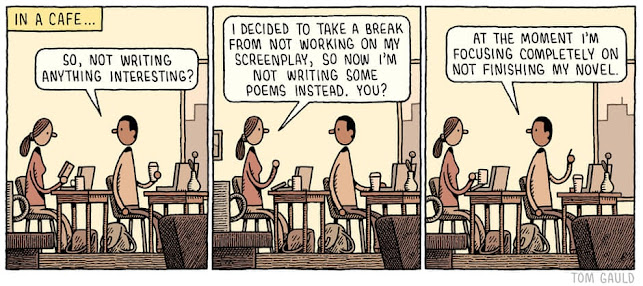
HOW LONG DOES IT TAKE TO WRITE A NOVEL?


Someone asked me yesterday how long it takes to write a novel. The National Novel Writing Month (=NaNoWriMo, November) makes folks who don't write novels think it takes a month to write a full-length novel for adults.


Articles such as this (from Writers Digest) give a wild range of two and a half days to sixteen years.


Seems to me the definition of what constitutes writing a novel is what needs clarifying, because these estimates are comparing apples to oranges, or more likely— watermelons to olives. Technically, both are fruits. But this is where the similarity ends.


It’s not only the size and scope, but what do they mean by “writing a novel in X number of days.”


If NaNoWriMo is the definer, we’re speaking about finishing a first draft. Writers know that is just the beginning. It has become a sort of fashion among genre writers to fast-draft a first draft. A month’s first draft will be followed by many more, but you could claim to have written the novel in a month.


When the claim is that it took many years, we are not speaking of working on the novel five days a week for years. These books had long stretches of sitting in a drawer, real or virtual, before the writer finished the umpteenth draft and called it done.


If we look for any kind of metric, those who do not write novels would do better to ask about the general rhythm or work discipline of different writers. Every day? Only on weekends? Now and again? How many hours at a writing session?


And there, too, are wild differences. No wrong and right, just long and write.

©Tom Gauld


Tuesday, April 16, 2019

Taking a Story from Picture Book to Novel


If you’ve been writing and submitting stories to editors or agents, eventually you might get a personal suggestion to take that short story you considered a picture book text and make it a novel for older readers, or take that chapter book and expand it to a novel for young adults.


This is what happened to The Voice of Thunder, which began as a short story I mistook for a potential picture book. This is also how many of the subsequent novels for middle grade readers I have written began their lives.


What does the suggestion to “expand” a story and re-fashion it for older readers mean?


Obviously, it must be longer. Not twice or thrice the word count, but ten to a hundred fold. A five-hundred-word story becomes a fifty-thousand-word story. But this tells of the size of the box, not its content.


Expanding means going both wider and deeper.


Wider pertains to the cast of characters, (more enter the scene) and plot, (many more twists and turns) and adding descriptive passages that the illustrations would have done in the picture book, even as the same arc is essentially already there. You already have the beginning, middle, and end. It’s all the stuff in and around the middle that the writer must conjure.


Deeper means extra layers of character exploration. This applies to all the characters, the ones who were there before and the new ones. They all have a past and wonder about the future. They all have layers of ambiguity where the various forces that drive a character operate, sometimes at cross-purposes.


Writers are advised to make sure the age of the protagonists match the intended readership. This, though a technical detail, also helps navigate the deepening of the characters.


Every time I undertook this challenge, I became ever more appreciative of the art of Picture Books writing. I marvel at how it was all in there in the short version. Longer takes more time, but shorter is harder, believe me.

©Chris Brecheens 2012


Tuesday, February 12, 2019

Writerly Routines


Most folks have routines that get them going no matter what sort of work they do.
Most writers I know, or know of, do their creative work in the morning. If writing is in addition to their day job, this means very early morning.


No matter when or what, routines help. It’s unglamorous. Admitting that you don’t write drunk into the wee hours of the night with existential despair as page after page is scrapped because you won’t give up until you have something--- doesn't sound arty.
(Oh-so very unlike Dashiell Hammett, at least as depicted in Lillian Hellman’s Pentimento.)

Most writers have a set routine and write no matter where inspiration chooses to dwell any given day. Most workers go to work no matter how enthusiastic they feel at a particular moment. Same thing.

© Luci Gutierrez for the New Yorker


My morning routine is as uninspiring as it is grounding. With small necessary adjustments, it generally goes something like this:


*Woken up by Nougat, one of my three cats. She thinks she’s an alarm clock.
*Thanking her, and thanking G-d for returning my soul to me. It’s a Jewish prayer that sets the day right.
*Making my bed. The other cats come in to help, with great merriment for all.
*Cleaning litter boxes, changing water bowls, filling the food bowls. Felines have priority because of all their help.
*Making strong tea with foamy milk. Drinking it, doing my best to keep cats off the foam.
*A short meditation. It’s supposed to be quiet time, but the cats determine this as well.
*Turn on the computer. Open WORD.
*I’m ON IT.


Two hours or so later, DH gets up and the rest of the day commences. That means coffee, breakfast, and the busy-busy stuff.


Do you have routines to get going?


Tuesday, October 30, 2018

Personal Process


A few months ago a writer on a kid-lit chat board asked how others approach revising a novel. She’s written many picture book texts, but this was her first novel. After completing the first draft, she was stymied as to the next step. “What do you do?” she asked.


Some responded with links to sites that gave directions, while others made specific suggestions. I realized that I could only speak of the way I work. After all, practice helps, and by now I have some. I haven’t published a lot, but I have written and revised a few middle grade novels, and am now working on a new story.


I copy my response here, because it says all I have to offer and because, as I said, I’m busy first drafting. A good excuse for taking the easy way on this blog today.


So here is my process, which may be of some interest, even as every person must forge their own.


It is personal, and it takes some experience to find how you work best. If you are experienced in Picture Book writing and revising, you might take some of what you have learned about your process to a novel. The only difference is the time invested in each draft and thus, proportionally, the time between revisions.


Speaking for myself, the first draft is a plow forward. I'm a combination planner and a bit of a panster, too. (This means I have a very thin outline before I even start, but the fleshing out is done by the seat of my pants, as the saying goes.) First drafting is the reason I am a writer, and for me the rest is the necessary work to make it better. As others said, some love one part and not the other. It's a somewhat different set of problem solving.


I don't even go near a novel for a minimum of two weeks between drafts. Two months is better. By "drafts” I am not referring to tweaks and repairing an inconsistency here and there. I mean substantial changes and meeting the phrasing with fresh eyes, more like a reader than a writer.

The first two real drafts are done with me alone. No one even hears what it's about. I have a lot to work out before I feel "I've got something there." 

Third draft comes after my first beta reader reads and gives developmental comments, points out inconsistencies, (thank you, you know who you are!) and catches typos. I go over the feedback carefully. Sometimes other matters arise for me while doing this.

When done, a full re-read after another break, and then a second beta reader. I look for a reader who might be different from the first in many ways, (mostly in their taste in books and their sensitivities) and when their feedback returns I mull over it in a similar way.

Another break, another read-through, and then I have my own checklist to make sure I have asked myself  if I am clear about the theme, foreshadowing, character development/change, Main Character solving the problem (or coming to terms with it) and so on.
Another read-through, mysteriously catching *even more* typos...


...and then it goes  on submission. When I had an agent, this was the point where I shared it with her, and her feedback made me revise again.  Another revision, sometimes two, before it went out. Subsequent editor's interest means more revising, and the happiest of all are revisions after contract.


As to the mechanics of "how," you really only have your reading ways and your reading eyes. It will not be different from the way you have worked on shorter picture book texts. One writer mentioned she makes a hard copy printed like a book. This is a good technique for many. Not what I use, but I know it helps. Another mentioned reading the text aloud, or having someone else read it back to you. There are some techniques for line editing, also. 


But never feel you must write many drafts, (Stephen King does only three, but to say he's experienced is an understatement) or that what someone else says is a must really is for your way of working. Some writers are very clean grammatically and phasing-wise, and some (like me) can never get rid of all the typos no matter how many times we go over the words.


While first drafting, I refuse to think of all the work to come. I suppose that if I did I might not have the strength to start. I’m glad I wrote this^ months ago, before I put my writing vehicle back in gear.


What's your way?

Tuesday, October 9, 2018

Blessed Are the Friends


You’ve heard the ubiquitous question, “where do your stories/ideas come from?”
Invariably the sweeping answer is, “everywhere.


But a truer answer is that different people tend to get ideas in idiosyncratic ways, specific to them.


I know writers who get a lot of stories for fiction novels from newspaper accounts of real life stories.


I know writers who get story ideas while walking and looking at houses, imagining the families who live there.


I know writers who get ideas for fiction from reading others’ fiction, and imagining how much more they’d have done with those stories.


About a year ago, I realized many of my longer stories got their themes or protagonists from a friend of mine. One specific friend. We have our regular walk & talk, and I’d be telling her something I had experienced way back, when she’d say, “why don’t you write your next story about it?”


She is not a writer, but an excellent reader. I owe the last five MG novel themes to her.