Tuesday, June 30, 2015

Me and the Blank Page

Oh, hum. A lament about what to write about.... Another one?
For some reason this is not a problem I have struggled with. Truth be told, (passive voice, I know. Phooey—rules!) I don't run out of things to say or stories to tell. This is not my problem.


 But who is listening?

So I sit (or walk, or vacuum) and think about you, the imaginary reader. What were you doing just before you bumped into my blog? What would add value to your mini-break from the things you must attend to, your own work, (official and unofficial) that which you care about and will get back to as soon as you click this page away?

And then, suddenly, the endless chatter inside me is silenced. The page goes blank.

I have no idea.

This is when I remind myself that Steven Spielberg said he makes the movies he’d like to see, and Stephen King said he writes the books he’d like to read. No matter that they're both Steves, sort of. They're also right.
And I get back to my internal clatter. Now I managed to write yet another post, and it entertained me.

And all’s well with the world.

Tuesday, June 23, 2015

It’s a Jungle Out There

Remember the frantic repetition from MGM’s The Wizard of Oz— “Lions and tigers and bears, OH, MY!”—?

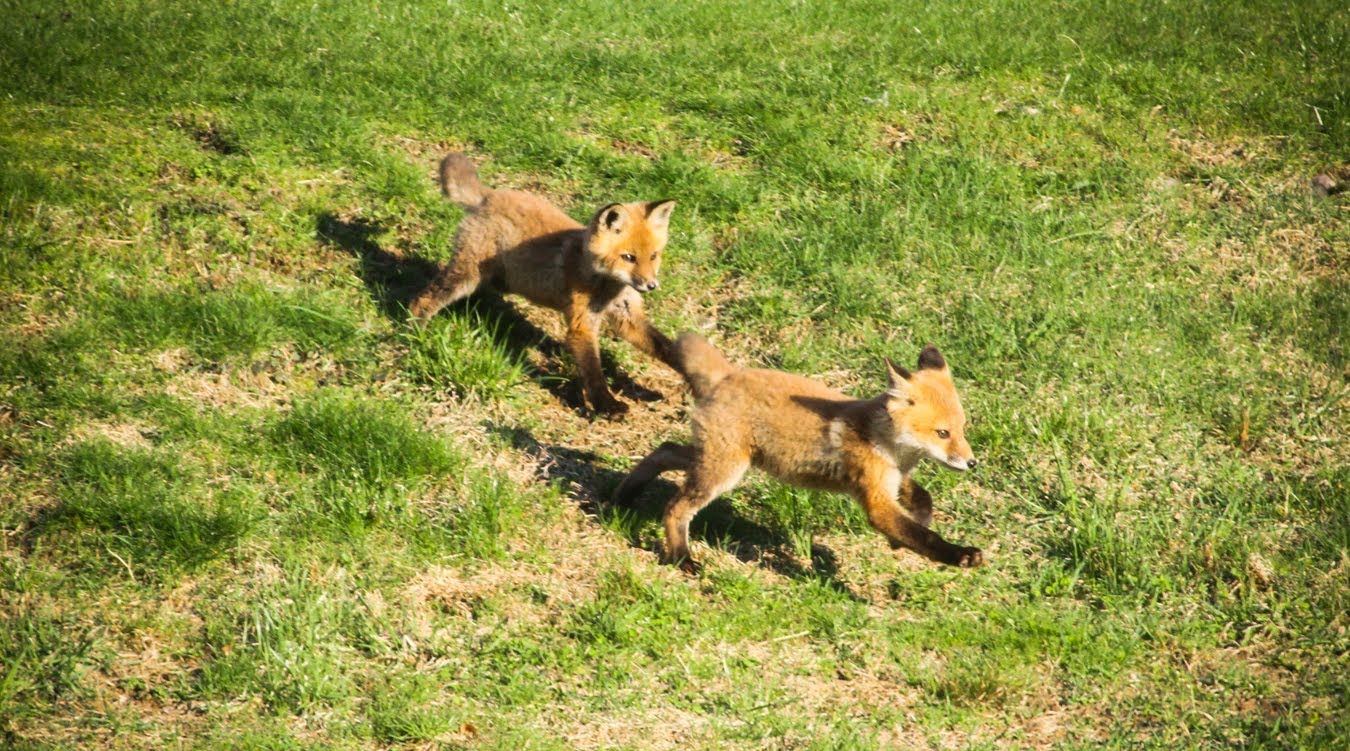
It’s beginning to resemble my back yard.


In addition to deer, (& their babies) and raccoons, (and their babies) and opossums, and squirrels, and small snakes, and crows, and swallows, we now have…


---FOXES!
And we live in the city.

The Mama doe chased my cats away from her babies, who were larger than my cats. The foxes, on the other hand, played (yes!) with my cats. They rolled on their backs on the ground, teasing as dogs do when they frolic about, and then played chase. But I imagine that if any of my cats were to approach the den where this pair of foxes has their babies, the parents would get ferocious and forget about play chasing. They'd likely cause real damage.

What a jungle!

On our part, we watch from the distance our small yard allows, no more than twenty feet, and try to photograph our guests with a zoom lens. 
We assume their habitat must have been nearby, and somehow got disturbed. Because until this spring none of these wild animals ventured into our small back yard so close to people. It is definitely unusual for foxes to come out for hours in the middle of the day, and let us get this close.

I do worry about my cats. I make sure they have a way to come inside in a hurry. But still…

Of the whole menagerie of uninvited guests, it’s the foxes that captivate me. They are monogamous, and raise their kits together, male and female sharing equally in the care of their young. Call them perfect!
They typically have six to ten kits at one time. I haven’t looked for their den, so as to not disturb their family. But three young'uns have been spotted at one time, playing with tennis balls left behind. They push them with their noses to one another. I kid not. The next thing you know I'll be reporting their newly invented tournament. Stay tuned.


I remind myself they are wild, and must stay that way. We do not feed nor offer our guest room to them. I hope they leave soon and find a home where they can properly roam.

The other day one of the foxes stopped by my window, not even three feet away from me, and we looked at each other.
“No cookies for you,” I said. The fox cocked its head a bit and kept looking.
“Nah-ah,” I repeated. Fox lowered its tail, and a second later was gone. Had it not returned with its mate the next day, no one would have believed me.


I hope we all have a happily-ever-after picture book ending. Oh, my.

Tuesday, June 16, 2015

Fail Better

“Ever tried. Ever failed. No matter. Try Again. Fail again. Fail better.”

A famous quotation. What in the blasted barnacles does failing better mean? This sounds profound, but is it?

Anne Lamott wrote in Bird by Bird that most of her writing students come to her classes not to learn how to write but how to get published. She doesn’t teach how to get published, and barely teaches how to write. What she does do is share her experience of struggle, perseverance, and failure. She is an engaging and successful writer, so reading about her fails is inspiring.

She perfected the better and best failing.


The stories we follow and the tales we tell are not really about failures. They are about overcoming first failed attempts. The more dramatic and the higher the stakes, the better the fail, er, I mean the ultimate success.
We really have no narrative of failure. Not the real kind. Not in literature and certainly not in the popular culture. True better failures are banned in storytelling. Even our narrative of history is the story of the victors.


Our failures are the stories of ultimate success. “If at first you don’t… try again.” We live on hope.
I know of no alternative. I intend to do better, not fail better, thank you.

Tuesday, June 9, 2015

CAT WISDOM

The French sociological positivist Hippolyte Taine said it perfectly:

“I have studied many philosophers and many cats. The wisdom of cats is infinitely superior.”

I have nothing to add because adding, in this context, would amount to the idiocy of the philosophers. Thus, I’ll let the cats do some of the talking—
And—
And finally, to prove the point—
Did you pet yours today?


Tuesday, June 2, 2015

BRAVE BREWING WORLD

It’s a new lingo. ‘Splain it to me, Lucy~~~*

*Quoting from I Love Lucy really dates me.
Just the other day I asked a techie how the word "cookies" came to be the tracking inserted by websites, as opposed to the things we make and bake with flour and sugar and spice. Techie didn't know, but launched a long explanation that was full of yet more Computerese.

Language is a flexible thing, never set in stone. Volumes of interpretation followed even the Ten Commandments, the original of which were set in stone. It’s a moving thing. And that’s good, because so is life.

But things have been moving so fast, and faster, that the temptation to get off the bus and unplug is growing. I'm getting tired of feeling like an idiot instead of the wise old crone I imagine myself becoming someday.

Few things are more unattractive than trying to pretend to be hip and with-it when your bones are creaking and your mental screws are showing hints of rust. I prefer those who respect their age and time. But this means being left out of the conversation.

Or maybe we can have our own? Let the rapid-rollers feel left out, for once.
Ok, maybe looking back won't do it. Those days had their issues.

No solutions here, just a mini-rant followed by a sigh. Got to go and click some likes, and then link this post to a tweet.

Tuesday, May 26, 2015

How Old? I Mean— How-Old.net ?

In late April Microsoft unveiled a site that for no charge or sign-in will let you upload photos of anyone and have the wizard of facial analysis tell you how old said person appears to be. Not how old he is, but how old he appears.

The thing seemed harmless if vacuous. But days later reports from search engines and Microsoft indicated that all over the world, at homes and offices everywhere, nothing productive got done the day www.How-Old.net was unveiled. Seems everyone was uploading photos all day and gasping at the instant analysis of appearance and age. Microsoft also revealed that most photos were of self. Selfies, in fact. And one per person was not enough. Folks uploaded more and more until they got the result they wanted, or fell off their chairs in exhaustion.

I don’t make a secret that I am not a nubile nymph. Age is now easily found on the Internet, though I would caution this is not as authoritative as you think. Mine appears to be two distinct ages— somehow DH’s slipped onto my online ID and so there is more than one of me out there, age wise. I assure you that the (much) older one is my better half, and the real me is fifteen years lesser. But this aside is about real age, not appearance. The new app is about appearance, and in specific photos.

I had to join the rest of the human race, the vainer among us and possibly not busy enough, and try this new app out.


If there are two of me age-wise out there on search engines, there were many more when I started playing. A few of the photos yielded results that got close, but the range was amazing. Using only clear photos taken within the last two years, I am apparently anywhere from thirty-three to seventy-one years of age.
I’m as vain as the rest, so I decided to quit while ahead. That is, after the HowOld.net said I appeared to be thirty-one. Wouldn't you? Except, of course, if you are twenty-nine.

Well, it was fun, in a masochistic sort of way. Mindless, too. But it brought home how far technology has to go to tell us real things about ourselves and others. Even something as technologically possible as face recognition and a quantifiable attribute as age are not there yet.

I’m doubtful they ever will be.

Tuesday, May 19, 2015

Say Nay to the Naysayers

You've heard all the “can't-be-done”s to last you a lifetime. Now it’s time to push ‘em back.

When I started writing with the intention to publish, I heard that someone who did not grow up with English as a first language should not expect to do what I set out to do. I heard this from those who supposedly were on my side.

When I set out to find an agent, I heard that since I had published before with small presses, I should not expect to get an agent, as they prefer so-called “debut” authors. This, too, came from helpful voices.

I was warned by writing friends that literary agents are likely to be expensive/uncommunicative/run away with the store. No wonder I took forever to make a decision to look for one.

They were wrong, wrong, and wrong again. But I spent too much time listening to their voices while ignoring the can-do ones. After all, the positive voices came from the how-to books, and they were selling something, right? The can't-be-done voices came from well-meaning friends and colleagues, and they cared enough to tell me the truth.

Only days ago DS graduated from our best public university with a double major, completed in four years. Good he’s young and wasted no time listening to the naysayers. They would have told him that "because of budget cuts" it’s hard to get the classes you need to graduate in four years with a single major, that double majoring will leave him without a social life and in a state of depletion, and certainly no time to also work part-time to help with expenses.


Wrong, wrong, and wrong again. There he is, saying no to the naysayers—

--And heading to get a graduate degree in Paris, France. Oh, yes. They told him Americans are rarely accepted to such.


I’m not just another proud mama, (well, I’m that, too) but a humbled one.
 Pushing away the negative voices, whether outsiders’ or my own, is something I will work on every day.

Tuesday, May 12, 2015

You don’t Know What You Don’t Know

…Until You Know It

Would you like to know the future? I mean, if a genie granted you the wish to see your timeline on this earth, would you take it?


We live on hope. Hope is an even more important fuel than food. 

You never know. Anything can happen. You could win the lottery. Or sell a book to a great publisher. The book could become a bestseller. The book could change the world, the way Uncle Tom’s Cabin did. The world could become a much better place. Or you could win the lottery. I know, I said that already, but I felt like repeating it just in case a genie was listening. You never know.

You can toil and try and do, and never publish again. Or publish something that will unleash venom in some unstable person. Unstable person would purposely run you over with their car, and you could lose a limb, or more. A loved one could be in an accident, or get sick, or— I don't want to go there.

Helping a friend with metastatic cancer has brought this point home for me. A friend who never smoked and took good care of himself is wracked with lung cancer. You never know.
I know cancer survivors who told me that, while they wouldn’t wish it on anyone, they now appreciate every moment. If only they had known what they now know they would have been in this state before, and without the cancer, thank you very much.

The one thing certain is that everyone will die. To quote the guy who helped me change a tire on the freeway long ago, “Ain’t none of us getting’ out of this here thing alive.” But then he added, “While we’re here we got to help each other.”

People of faith have even more, because hope goes beyond the boundaries of this world. But the mystery about what is next, in this world or the next, is the one thing certain. 

Because you don’t know until you do. Would you want to?


Tuesday, May 5, 2015

Is Twitter for Twits?

I recently joined Twitter, more out of curiosity, (and a tiny soft suggestion from my agent) and immediately found it overwhelming. It was less than a smidgen of a second later, and I was already in a sheltering mode sending all notifications to my look-at-it-later folder.

It felt like an unfamiliar jungle, and I couldn't remember why I tried it in the first place. 
A few weeks have passed, and I am coming out from under the chair. Gingerly, carefully, I'm picking my head up to glance, but only in small increments.
You see, I remembered that this was my reaction to joining Facebook. I had a page, an account, and it was practically dormant for ages. I made peace with it and like seeing others’ photos there.


I had this reaction to Blogging, which seemed to me fit only for those with too much time on their hands, both on the reading and the writing ends. I committed to a regular schedule, and slowly it became something I love to do. Of all the virtual socializations I felt dragged into it is now my favorite. But it wasn't at first; it took (I should be honest here) at least a year to feel it was more a necklace than a noose.

This is not an endorsement of Twitter. I still don’t get its charms. But it is an endorsement of trying something. It’s about doing it long enough to know what its charms may be before you know how, or if, you fit in. Because, obviously, millions of Twitter users have. I know some of them personally and can vouch they are not twits.

Try it. You may or may not like it. But trying is a positive act.

Tuesday, April 28, 2015

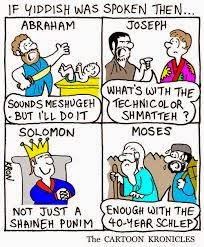
Empowering in Yiddish

Every language has a personality, and when I think about Yiddish, I think “self-mocking,” “Ironic,” and “wistful humor.” The last contains the contradiction that makes the Yiddish voice, or narrative personality, so hard to define and yet so appealing. We all know the best storytelling makes you cry and laugh at once.
What Yiddish does not connote is power. It is the language of a people who were shaped by powerlessness. Even a blunt statement such as “you can't pee on my back and tell me it’s raining” suggests someone is humiliating you while you're determined to stand tall. (A parallel idiom in English would be, “I don’t take wooden nickels,” and it is clearly of a different, self-possessed, voice. Both mean you can't fool me. But they don't taste the same.)


So when I heard this saying translated from Yiddish—
 וואס אין אים פאלט מען אריין קען מען פון אים ארויספאלן.
*What you fall into you can fall out of*

I’m going to repeat this^ to self as often as needed. In Yiddish, English, Hebrew, or by thinking while humming intelligibly. If I did it I can undo it. Wow-wee.


Tuesday, April 21, 2015

It’s Not Only WHAT You Say…

… But also HOW you say it.

Thomas Hardy said that if Galileo had said in verse that the world moved, the Inquisition might have let him alone. To say something that challenges world perception, it is best to speak softly.

Or even better, with humor. 
A lot of opinionators have discovered that making us laugh lowers our defenses. Rhyming well is a neat trick to make the listener dance inwardly, and join the party.


As I revise my current WIP, (writerly shortcut for Work In Progress) I take at least a month between rounds, and when I return I do more than catch the yet-another-how-did-I-miss-that typo. I check to see if I’m laughing, or at least chuckling.

 I don't write humor; I'm very serious. But I find that the only way to not be utterly insufferable (a real hazard for us serious types) is to be funny. Occasionally tickle the reader’s midsection so she buckles a bit, her head lowers, her mouth opens in laughter, and something the reader was determined not to allow in just does.


In this case, the reader is me. I tell the writer, (also me) “Surprise me. Make me laugh.”

Tuesday, April 14, 2015

Tax Day Musing


April fifteen just about here, and all over our great nation folks are slaving away to get numbers in order and pay, or at lease pay homage to that other sure thing, taxes.

 A dear friend all the way from my elementary school days, from the far-far-away country we grew up in, was celebrating finishing the deed. Taxes done, wipe brow, let’s raise a steaming hot chocolate to that.

 Unlike me, my childhood friend, who now lives minutes away from me, had had a grown up career in the homeland, Israel. Before she came to the U.S.A. she was already a gainfully employed physician, working in hospitals there, and paying taxes. I came to America when I was still a teen.

 I have no recollection of ever seeing my parents, or any adult, slaving to prepare their taxes. I don’t remember any “Tax Day” or tax-time. Israelis pay a higher tax rate than most, so what was I missing? I shared this with my old friend. Where were we when the grown ups paid taxes? Was I in a coma, or am I suffering some memory block because it was so traumatic and better forgotten?


“Here, in the U.S.A., taxes are mandatory but the reporting is based on an honor system,” said my friend. “The government expects you to tell them all you have earned. In Israel taxes are taken off the top of every payment you ever get. Period.”

 “So it’s not a report-and-possibly-get-audited, but basically we trust you to do the right thing, like we have here?” I said.

 “Trust? Trust you to pay? Are you kidding me? In Israel?” said my friend.

 And then it occurred to me. For all the craziness of our system, the impossible-to-follow maze of rules and deductions we’ve got to navigate, we have something to celebrate.

 When it comes to reporting, we have an honor system.


Call it a bit of light in an otherwise no-fun day. Cheers.


Tuesday, April 7, 2015

What Do Children Understand, and When?

There’s that repeated question adults, and kid-lit writers specifically, often posit: will kids this-or-that age get this?
Kids understand plenty. That’s where I start from.

Just the other day, while I was in line in the bank, a baby in a stroller with his mom behind me showed me his shoe.
“Shoe!” he said, pointing at it.
I confirmed by repeating, “Very good. Shoe.”
“Eye!” he said, pointing at his eye.
“Yes, very good,” said I. “Eye.”
“Nose!” That was his nose. I confirmed his word, again.
Then he stuck his tongue out. I was waiting for him to say, “Tongue!” but he just kept it there. Then he laughed.


Fortunately he was irresistibly cute. I think he was about 15 months old or so. He’s going to be quite an operator, or at the very least a lion-tamer, I predict.
My adorable little buddy from the bank had mastered the art of excreting the reactions he wanted, and reveled in his ability to engage.


Children don’t have the vocabulary we have, though their passive vocabulary is greater than most of us imagine. They don’t know history, or geography, and they are not connected as they will be after puberty to the procreative impulse. But they understand and, I believe, excel at non-verbal cues.

Children understand other people. It is their business to. I have vivid recollections as a child, watching someone say one thing, when I just knew he didn't mean it. I sensed what people felt and it was easy. I couldn't believe adults around me couldn't see what I saw. Then I grew up, and it isn't as easy anymore. I second guess my perception all the time, and miss.

How many times have you heard, “I don't think kids will get this?” It’s too facile to fall into that trap. But how can we tell?


Personally, I find that different kids, like different people, get different things at different times. The key word is, ahmm, “different.” But there are a few ways I have learned that keep me from underestimating younger human beings’ ability to understand.


The first, and the one I return to because it’s the best I got, is remembering me as a child at that age.

The second is observing my own kids and their friends. This is helpful for writing dialogue uttered by younger people. But it is not as effective for gauging their internal grasp, which much exceeds their verbal expression.

The distant third is listening to feedback that challenges kids' understanding or interest. I always weigh it, and sometime revise. But it is a lightweight consideration after the first two.

Tuesday, March 31, 2015

PLOT or CHARACTER?

The old chicken-and-egg debate has a writerly version. Should you start from plot, or from character?

My usual answer would be that it doesn't matter as long as you start. Don’t delay. Don’t think, mull, or pray. Do it.
At least that’s what I tell reluctant self when, once again, reluctant self professes that it doesn’t know where to start.


I've read variations of this discussion on writers’ blogs, How-to books, and in interviews with great writers. I was aware that most literary writing is firmly anchored in character, and in some cases barely has a plot. I noted that many bestsellers (“commercial fiction”) are impressively plotted while the characters seem more stock. Not everyone can write like Dickens and excel in both. (And speaking of Dickens, I don't think there was a consistently better writer of first paragraphs, but I digress.)
But when I reflected on my own process, I realized that with a few exceptions, most of my stories began stewing with neither. They began with theme.


didn't know what* happened, and I didn't know who** was there. What I knew was that I wanted to find a way to think about something***, and that the way was through conjuring a story.


*=Plot
**=Character
***=Theme

Oh, dear. I just complicated the chicken-and-egg thing. I added the nutritional information bar. Maybe this is a good place to stop mulling about, and start.  

Tuesday, March 24, 2015

LOGIC versus LOGISTICS

I have a dear Beta reader whose logical mind helps catch inconsistencies and discontinuities in my stories. Every writer should be so lucky as to have such a reader go over their work. When she puts in the margins “this does not make sense to me”—  I know it is not a reaction to something that does not exist in the real world, but something that could not exist in the story’s created world.


The story’s scenario must make sense from within. Because the rules of our every day world may not apply, it must really truly absolutely make sense. In the same way that a story told from the point of view of an insane narrator creates an internal perspective that is coherent even if delusional, we must strive to take a reader with us into a delusional state.
Sounds crazy? It sort of is.


Protagonist: “Close the window, it’s cold outside.”
Antagonist: “And if I close the window, will it be warm outside?”

Logic is overrated when it comes to any spiritual flight, and a good story provides just that—
 a magical ride.

Tuesday, March 17, 2015

Newbery/Dinglebery Syndrome

A cleverer writer coined this wonderful expression of artistic bipolar mood disorder. It struck me as an apt description of what every creative person in a competitive field goes through:
The Newbery/Dinglebery Syndrome.


Readers of fiction in English know The Newbery. It’s the Oscars of kid-lit, the Pulitzer of books for pre-teens. There’s only one Newbery medal awarded, but as many as eight Newbery honor books each year. They represent exquisite literary accomplishment in children’s books.

Haven't heard of The Dinglebery? There’s a reason for that.


In the process of writing, revising, and submitting to agents or publishers, most every writer goes through an astonishing rollercoaster of feeling their work is so very good it amazes even them, and that it is so worthless even the trash-bin would not accept it for disposal. All in one week.

Some of it is external. Got a rejection? Another one? Must not be half as good at this as I imagine, I mean one-tenth as good… who am I kidding. Not one-hundredth as good.

Got a request for a partial? This is a busy uber-editor/agent and they don’t ask unless the premise stands out. A request for the full manuscript? Nobody asks for those unless the premise shines and the partial sparkles. I must be good at what I do. Got a YES to the whole thing? The Newbery Medal is calling.

Some of this rollercoaster ride is internal. Staring at a blank page and there is nothing in my head? Staring at a pivotal chapter in need of writing and there’s nothing coming? Having written said chapter, and every word feels wrong? Ding-ding-Dinglebery.

Having a day where the words flow out and things get written by a seemingly invisible hand with cadence worthy of Mozart? Zingers are pouring out worthy of Groucho Marx? Insights that are deep and entertaining  at once,  reminiscent of Twain? I’m in Newbery territory here.

I've been there, in both places and a few in between. It is part of the course. It’s just the way it goes. In truth most of our work falls somewhere between a Newbery and a Dinglebery, but the process is much more like these extremes.


Don't let anyone tell you to never doubt yourself and always believe in your work. It’s not possible, and not that healthy, either. But don't let them tell you to give up, either.


P.S.
Having a Newbery week, and wishing the same to you~

Tuesday, March 10, 2015

Charmed by PASSIVE CONSTRUCTION

One of the many writerly rules is to avoid the passive voice.
I'm on record as ranting about “rules” and the slavish following of these tenets. Sure, the How To books on the art of writing would be out of business if only folks like me existed. But there is no danger of that. Books that promise to make an artist out of anyone are doing fine, thank you. Better than the books they promise they'll help you create.

I get an achy feeling every time I see yet another suggestion that ignores powerful and effective writing because it breaks some rule learned in rule-going-school. I do think it’s good to understand the rationale of those edicts, but only apply them when the writing is limping, and the application of the rule hits the Vagus nerve as a clear step up. Y’ know, an “AH-AH!”

I have the tendency to use a lot of passive construction. I have acquired the discipline to minimize this proclivity in my fiction writing. This is a good thing, as my wonderful agent has a particular pet peeve regarding the passive voice. She and I agree that USE WITH CAUTION should guide professional writing.
But don't take it away from me when I write Emails, blog-posts, or even when I speak.
Something about being vague that I find comforting and less confrontational.


That is my point. The passive construction has a place. It is useful. Think of a film shot with a lot of fog. It’s mysterious and unclear and it is not the same film shot with a crisp lens.
wouldn't write a business proposal using passive construction. A clear and dynamic voice is important for such. But many a fiction story would benefit from some veiling.


P.S.
I do think the phrase “a good time was had by all” is an example of misuse, so abuse of the passive voice is something I recognize.
I’m in the use-don't-abuse camp.

Tuesday, March 3, 2015

Why Do We Hunger for Sequels?

The hysterically enthusiastic reaction to the announcement that Harper Lee, the author of the American literary classic To Kill a Mockingbird, will publish another novel, (this one the original version of the story written before the published masterpiece) was both understandable and also, if I dare say, a bit pathetic.

On the Blogosphere I read writers and readers who chimed in that they already pre-ordered the second book, could hardly wait, and that the discovery of an abandoned manuscript made their day.


Ms. Lee, by all accounts a reclusive person who had said until last year that she would never publish another book, had apparently changed her mind. Or was it her new Lawyer who changed it for her? Or, perhaps, was it pressure from family members who would like to have more $$ in Ms. Lee’s estate? The conspiracists were already weaving their tales.  
What is the truth? Who knows? How much does it matter? It’s a great story. Our hunger for great stories is the one thing certain.

This whole evolving sequel to what was expected to be a quiet retirement by a great storyteller left me with a bad taste in my mouth. It echoes our obsession, even demand, for sequels. Even if in this tale the sequel was written first and the published first book is really a prequel, and so forth and so on… whatever. 

Loved the book? Please, please may the writer write a sequel. A great movie? I can't wait for the sequel. 
A stand-alone story better have a nailed-shut ending, maybe one like Hamlet’s, where everyone who matters dies. But wait, why isn't there a sequel to Hamlet? Maybe he can come back, y’know, like the ghost his father did in the original.

I’m not a fan of sequels. I even like ambiguous endings, and I don't need “the rest of the story.” To Kill a Mockingbird is a great book. There have been more than twenty published sequels to it, by other writers, that took nothing but added nothing to the original.

Don't blame the publishers. Sequels are cash-cows and publishing is a business. Don't blame the writers of series, because some stories were meant to be, and were originally written as, series.

But some, I am certain, are stand-alone stories, and should be left alone, people.

I’ll stand alone for standalones. Best. Books. Ever.